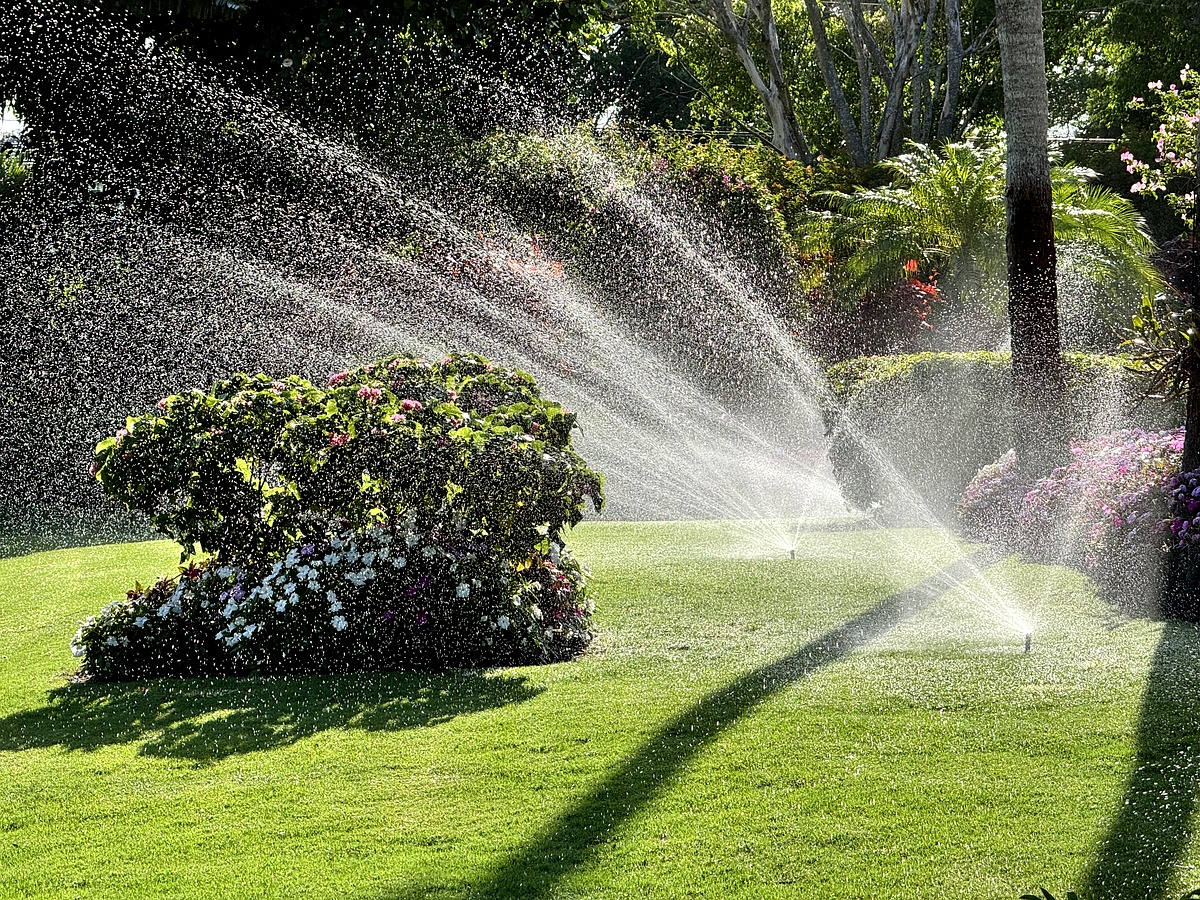
South Florida runs two completely different watering seasons, and most sprinkler systems get programmed once and left alone. From roughly late October through May the air is dry, the soil dries out fast, and a lawn genuinely needs the controller doing real work. Then the pattern flips.
By mid-June the afternoon storms roll in almost daily, the water table climbs, and the same schedule that kept the grass alive in March is now drowning it. A system tuned for the dry season and left running into the wet season is the single most common cause of the lawn problems we get called about in July and August.
Late spring — roughly mid-May into June — is the window to get ahead of it. The grass is in full growth, the rains haven’t started in earnest yet, and every leak, misaligned head, and tired solenoid is still visible.
Once the daily rain starts, a wet spot in the turf could be a broken lateral line or it could just be Tuesday’s thunderstorm. You can’t tell anymore. That’s why we treat the pre-rainy-season tune-up as its own service rather than something we fold into a regular mow.
The dry-season schedule that kept your lawn green in March will rot it in August. Same heads, same controller, same yard — the weather changed and the programming didn’t.
Why Rainy-Season Programming Is a Different Animal
Three things change when the rains arrive: how long you run, how often you run, and what time of day you run. Most owners only ever touch the first one, and usually in the wrong direction.
Frequency is the big lever. A St. Augustine or zoysia lawn in the dry season often needs water three or four days a week. In the heart of the rainy season, two days a week is plenty, and there are weeks where one day — or none — is correct because the sky is doing the job for you.
The goal in summer is not to keep the soil constantly moist. It’s to supplement the rain only when there’s a genuine gap, and to let the top inch of soil dry out between waterings so the lawn doesn’t sit wet.
Run time matters less than people think, but it still moves. We run rotor zones around 35 to 45 minutes and spray zones around 12 to 18 minutes per cycle, because deep and infrequent beats shallow and daily — that trains roots to go down instead of sideways. A daily-but-short summer schedule produces a root system two inches deep that falls apart the first time it’s stressed.
Time of day is the one almost everyone gets wrong. Irrigation should finish before sunrise — we set start times so the last zone wraps by about 6 a.m.
Watering in the evening or overnight leaves the blades wet for ten or twelve hours, and in a South Florida summer that warm, wet leaf surface is exactly what every turf fungus is waiting for. Watering pre-dawn lets the sun dry the canopy within an hour or two of the cycle finishing.
If your system runs at 8 p.m., that change alone prevents more disease than any fungicide. The full method is on our irrigation page, but the schedule shift costs nothing and it’s the highest-leverage move on this whole list.
The Rain Sensor Almost Nobody Has Set Right
Florida law has required a working rain shutoff device on automatic irrigation systems since the early 1990s. Almost every system has one bolted to a fascia board or a fence post. Maybe a third of them actually work, and far fewer are calibrated correctly.
A rain sensor that doesn’t function is the reason you see sprinklers running in a downpour — the single image that makes neighbors roll their eyes and drives a water bill up for no reason.
Most rain sensors are simple: a stack of cork or fiber discs that swell when wet and trip a switch, interrupting the controller until they dry out. Two things go wrong. The discs degrade and stop swelling after a few coastal summers, so the sensor never trips.
Or the adjustment ring is set so high — the 1-inch setting instead of the 1/8 or 1/4 — that it takes a tropical-storm rainfall to activate, which defeats the point. For rainy season we set the threshold low, on the order of 1/4 inch, so an ordinary afternoon storm actually pauses the next cycle.
Testing a rain sensor takes two minutes: trigger a manual zone, then press the discs or pour water on the sensor and confirm the zone shuts off. If it doesn’t, the sensor’s dead and it’s a small part to replace. Wireless sensors add a battery and a receiver that both fail quietly.
This is the first thing we check on a tune-up because it’s the cheapest fix with the biggest impact on the water bill, and it’s the one item most owners assume is fine because something is mounted on the wall.
Walk Every Zone Before the Water Table Rises
The core of a tune-up is running every zone manually and watching it from the yard, not the controller. A controller tells you a valve opened; it tells you nothing about where the water landed. Much of all irrigation waste is water thrown onto driveways, sidewalks, and the street by heads that drifted out of adjustment over a dry winter.
Head Alignment and Arc
Spray heads and rotors drift. A mower clips one, a car tire crushes a riser, a settling head tilts and starts watering the fence instead of the turf. After a dry winter of foot traffic and mowing, a meaningful share of heads on an average property are spraying somewhere they shouldn’t.
We straighten risers, reset arcs so a 90-degree corner head actually covers 90 degrees and not 180 onto the pavement, and swap nozzles where someone mixed spray and rotor heads on the same zone — a mismatch that guarantees one part of the lawn is always too wet or too dry.
Matched output across a zone is the difference between even color and a lawn that stays patchy no matter how much you run it.
Leak Detection Before the Rains Hide It
This is the timing-critical part. A slow leak on a lateral line shows up in May as a soft, spongy spot or a patch that’s greener and faster-growing than everything around it. A broken head geysers. A cracked fitting underground bubbles to the surface. In late spring, with dry soil everywhere else, those signs are obvious.
Once the daily rains arrive and the water table comes up, the whole yard is damp and a real leak disappears into the background — until the water bill arrives or a sinkhole-soft spot opens up. Finding and fixing leaks now, while the contrast is high, is the entire reason late spring is the make-or-break window.
When a head or line is past adjustment and needs replacement, that’s straightforward sprinkler repair work, and it’s far cheaper caught in May than discovered on an August water bill.
The Controller, Valves, and Solenoids
The hardware between the water source and the heads is where the quiet failures live. A tune-up checks the parts that don’t announce themselves until a zone won’t shut off or won’t turn on.
At the controller, we confirm the backup battery still holds a date and time — a dead battery means a power blip resets the whole program to the factory default, which is usually “water every day,” and nobody notices until the lawn yellows. We also check that each zone’s wiring is tight, since corrosion at a terminal in a humid garage makes a zone intermittent and maddening to diagnose later.
At the valves, the failure points are the solenoid — the electromagnetic coil that opens the valve — and the diaphragm inside. A solenoid that’s starting to fail makes a zone slow to open or causes it to weep after shutoff.
A torn diaphragm makes a valve refuse to close fully, so a zone trickles 24 hours a day, which is both a water-waste problem and a constant-wet-spot problem feeding fungus. We pull valve box lids, check for standing water (a weeping valve or fitting leak), confirm wire splices are in waterproof connectors rather than bare twists corroding underground, and exercise each valve so it opens and closes cleanly.
These are inexpensive parts. Finding the one that’s tired before it strands you with a stuck zone is the whole point of doing this in the off-week rather than as an emergency. Owners on a maintenance plan get this folded into the season; for everyone else it’s a one-visit service.
What Over-Watering Actually Does in Rainy Season
The reason all of this matters isn’t tidiness. Over-watering a South Florida lawn in the rainy season does specific, expensive damage, and it’s the root cause behind most of the summer lawn calls we get.
The first thing it does is feed fungus. Warm temperatures plus constant leaf wetness is the exact recipe for the diseases that plague St. Augustine here — gray leaf spot, brown patch, take-all root rot. A lawn watered pre-dawn twice a week shrugs these off.
A lawn watered nightly is a petri dish, and you end up paying for fungicide to treat a problem the controller created. We get into the disease side of this on the turf health care program write-up, but the cheapest fungicide is a correct watering schedule.
The second thing is shallow roots. When water is always available at the surface, roots never have a reason to chase moisture downward.
You get a lawn with a root system two or three inches deep — fine until the first dry spell or disease stress hits, at which point it collapses fast because it has no reserve.
Deep, infrequent watering builds roots that go six inches and ride out the same stress.
The third is nutrient leaching. Every gallon you push through sandy South Florida soil past the root zone carries dissolved nitrogen with it, straight down toward the aquifer.
Over-watering doesn’t just waste water — it flushes the fertilizer you paid for out of the root zone before the grass can use it, which is why an over-watered lawn often looks hungry no matter how much you feed it.
Tighter watering keeps both the nitrogen and the dollars where they belong, and it ties directly into how we time feeding on the lawn care side.
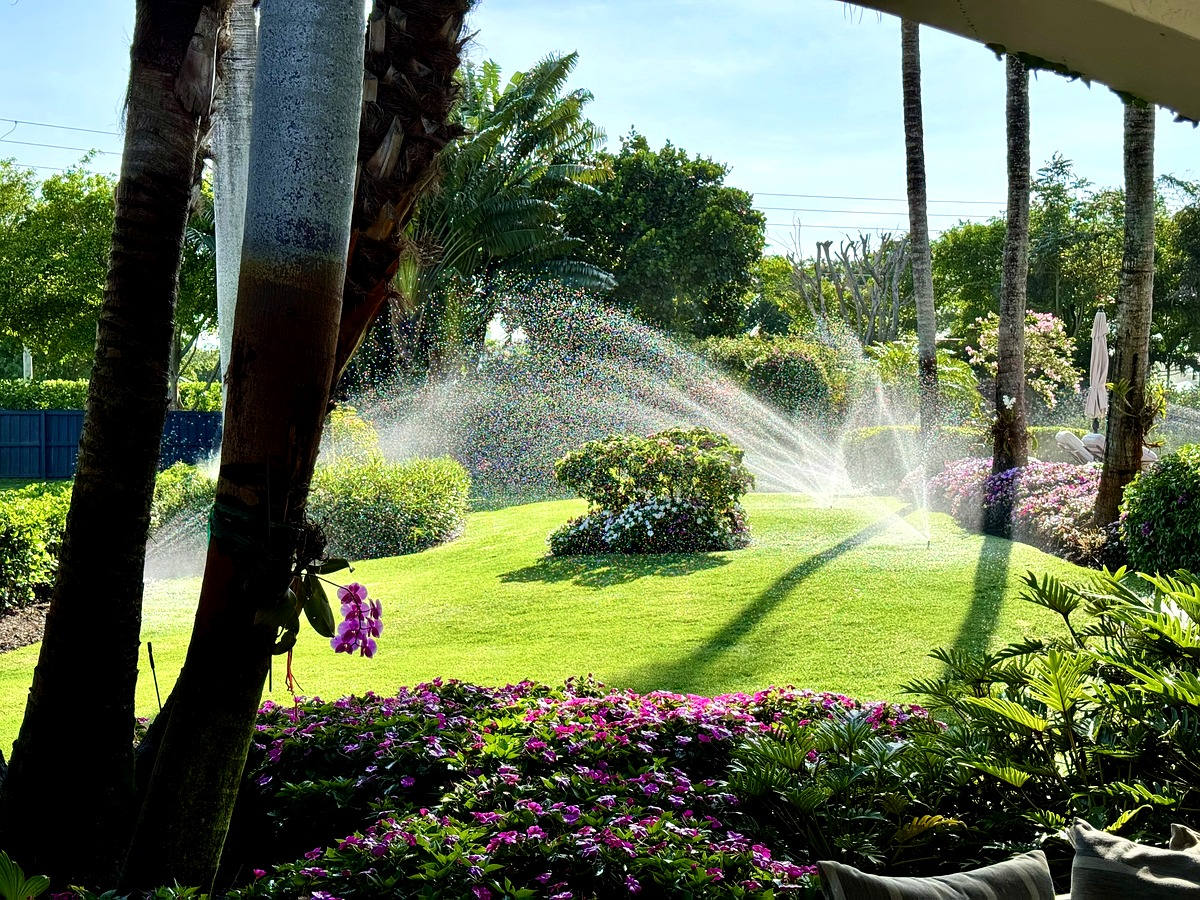
Heads aligned, arcs reset, cycle finishing before sunrise.
Water on the grass, off the pavement, and dry blades by mid-morning.
A Realistic Rainy-Season Schedule
There’s no single correct program because soil, sun, slope, and grass type all move the numbers. But as a starting point for a typical coastal St. Augustine or zoysia lawn heading into summer, here’s roughly where we set things and then adjust by watching the lawn:
- Frequency: two days a week to start — e.g. a Wednesday/Saturday rotation — then back off to one day in genuinely wet weeks.
- Run time: rotor zones 35–45 minutes, spray zones 12–18 minutes, adjusted so each cycle puts down roughly 1/2 to 3/4 inch.
- Start time: early enough that the final zone finishes by about 6 a.m. — never an evening or mid-day start.
- Rain sensor: threshold set around 1/4 inch so ordinary storms actually pause the next cycle.
- Seasonal adjust / water budget: if your controller has a percent-adjust feature, drop it to 50–70% for the rainy months instead of rewriting every zone.
The right number is whatever keeps the lawn a healthy green with the soil drying out lightly between cycles. If the lawn turns bluish-gray and footprints stay pressed in, it needs a touch more; if it never dries out between waterings, you’re running too long. A smart controller or a seasonal-adjust setting makes that tuning a dial, not a full reprogram.
What a Tune-Up Actually Saves
Irrigation is usually the largest single driver of a property’s water bill, and in the rainy season a mis-set system is pure waste — you’re paying to water grass that’s already soaked from above.
Cutting a summer schedule from four days a week to two, fixing a weeping valve that ran 24/7, and getting a dead rain sensor working again routinely take a noticeable bite out of the monthly bill.
Add in the lawn damage you avoid — the fungicide treatments, the re-sod on a rotted-out low spot, the shallow-rooted turf that fails in the next dry spell — and the tune-up tends to pay for itself inside a season or two.
What to Book Now
If your system has been running on the same schedule since winter, here’s the priority order heading into the rains:
- Reprogram for the wet season — cut frequency, set start times to finish by 6 a.m., adjust run times for deep-and-infrequent.
- Test and calibrate the rain sensor — confirm it trips, set the threshold low.
- Zone-by-zone walk — straighten and realign every head, reset arcs, swap mismatched nozzles.
- Leak check — find soft spots and weeping valves now, while dry soil still makes them visible.
- Controller and valve check — backup battery, tight terminals, healthy solenoids and diaphragms.
Most of this is already on the calendar for owners on a full plan in Boca Raton, Delray Beach, Pompano Beach, Lighthouse Point, and Deerfield Beach — the wet-season reprogram is part of the annual rhythm. For everyone else, late spring is the moment to schedule it, before a leak disappears into the daily rain.
The Honest Version
An irrigation tune-up is the least glamorous service we offer. Nobody photographs a recalibrated rain sensor.
But the lawns that sail through a South Florida summer without a single fungus call or a re-sod bill are almost always the ones where someone reset the controller in May, walked every zone, and fixed the weeping valve before the rains hid it.
The system that’s “working fine” in April is usually the one quietly wasting water and setting up a disease problem for July — it just hasn’t shown you the bill yet.
If you want a second set of eyes on your system before the rains settle in, that’s a property walk we do for clients in our service footprint. We’ll run every zone, flag what’s drifted, and tell you honestly whether it needs a tune-up or just a schedule change. No quote pressure, no upsell — just a straight read on where the system is heading into summer.