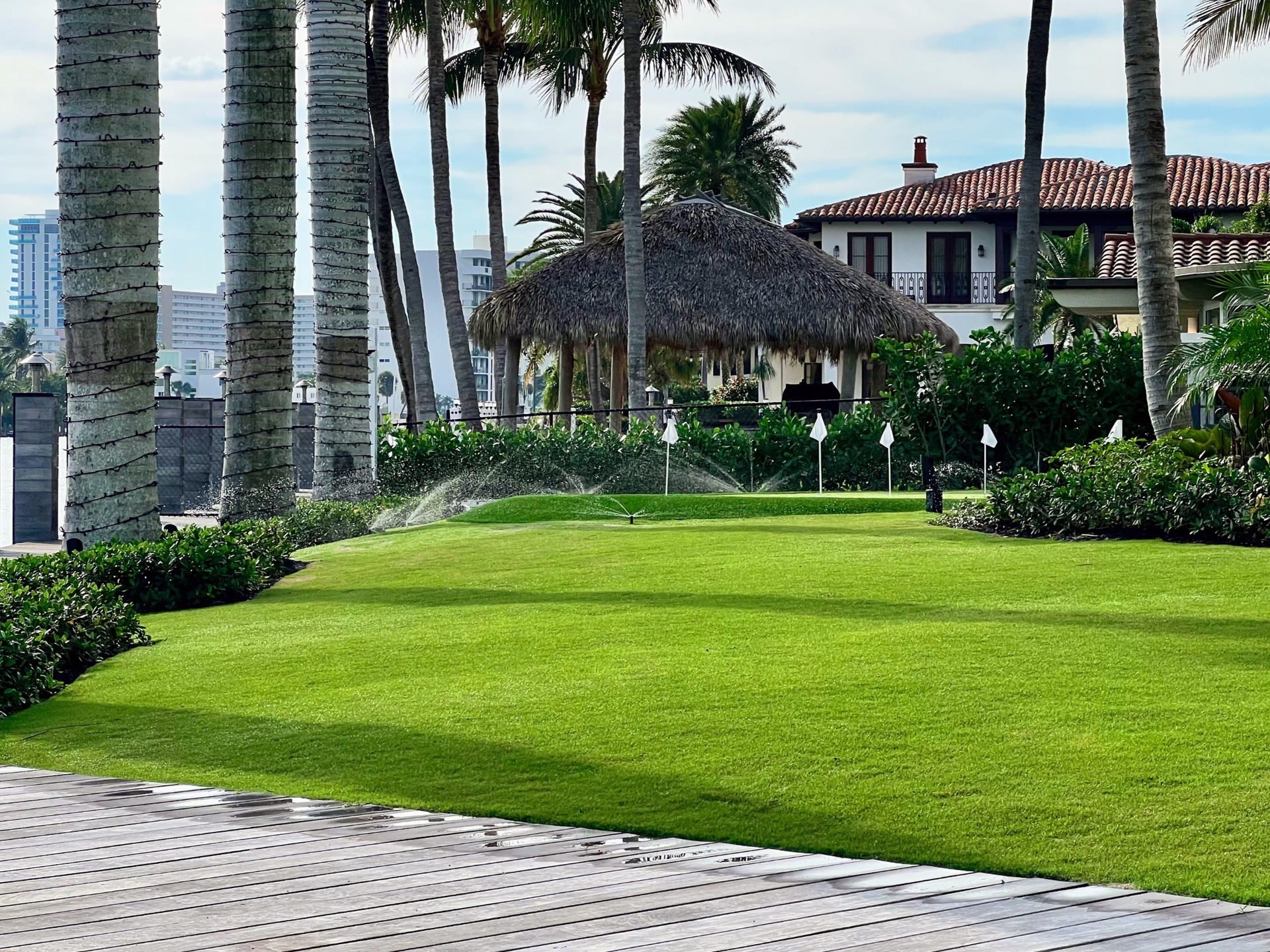
Most South Florida lawns are over-mowed and under-cared-for. The homeowner hires a weekly cut, the crew shows up, drops a deck mower to three-and-a-quarter inches, trims the edges, blows it off, and leaves. Repeat for years. The lawn gets by, but it never really gets better. It just gets flatter.
A country-club fairway doesn't work that way. Neither does a premium private lawn that actually looks premium. The difference isn't the grass — the same Paspalum, Zoysia, or Bermuda is available to anyone. The difference is the turf health care program behind it: aerification, verticutting, top-dressing, proper reel mowing, and a seasonal rhythm that lines up with how grass in South Florida actually lives.
This post walks through what a real program looks like, why each piece matters, and why the cheap weekly-cut model will never get a lawn to the finish level some homeowners are chasing. If you've ever looked at your yard after years of service and wondered why it still doesn't look like the pictures, this is the reason.
Mowing maintains a lawn. A turf health care program builds one. You can't fix years of compacted, thatched, under-fed turf with a sharper blade — you have to go at the root system, the soil, and the canopy at the same time.
Why South Florida Turf Needs More Than Mowing
South Florida throws three problems at a lawn that Northern turf never has to deal with: sand-dominant soil that doesn't hold nutrients, a nine-month growing season that compounds every bad habit, and salt plus heat stress along the coast. A weekly deck-mow program might be fine in a Midwestern suburb. Here, it falls apart within a couple of seasons.
Three things quietly kill South Florida lawns over time:
- Compaction — from crews walking the same paths, mowers running the same lines, and sand settling into hardpack under the root zone
- Thatch buildup — the layer of dead stems and rhizomes between the blades and the soil, which blocks water, nutrients, and air
- Canopy decline — the grass loses density from the top down because it's cut too infrequently, too tall, with a dull blade, and never properly groomed
No amount of fertilizer fixes those three. You have to mechanically work the turf to reverse them. That's what a health program does.
Aerification: Opening the Lawn Back Up
Aerification (sometimes called aeration) is the mechanical process of punching holes in the turf — either by pulling cores out of the ground or by driving solid/tine-style spikes into it. For South Florida's sandy, compaction-prone soil, this is non-negotiable if you want healthy turf long-term.
Core Aerification vs. Tine Aerification
Core aerification pulls actual plugs of soil out of the ground and leaves them on the surface to break down. This is the gold standard because it physically removes compacted soil and creates room for new roots to expand. It's the same method used on golf greens and top-tier fairways.
Tine (or solid-tine) aerification drives spikes into the turf without removing cores. It's less aggressive, causes less surface disruption, and is often used on finer turf between deeper core passes. Great for in-season relief on premium Paspalum or Zoysia where you want to reduce compaction without tearing the canopy apart.
When We Aerify in South Florida
The right window is late spring through early summer — exactly when the grass is starting to push hardest into the rainy-season growth explosion. Aerify too early and the turf is still waking up; aerify too late and you miss the recovery window. On premium lawns we'll often do a core pass once a year and a lighter tine pass mid-summer to keep the root zone breathing.
Pair aerification with top-dressing (next section) and the results compound. Pair it with nothing and you've still done a tremendous amount of good for the root system.
Verticutting: Cutting Through the Thatch Layer
Verticutting — short for vertical mowing — runs a set of thin vertical blades through the canopy to slice out thatch, remove lateral runners, and stand the grass back up. Done right, it transforms a lawn. Done wrong or skipped for years, the thatch layer keeps thickening until the lawn is essentially growing on top of itself instead of in the soil.
Bermuda and Zoysia are especially prone to thatch in South Florida because they grow so aggressively during the warm season. You can have a lawn that looks green from the top but is fundamentally unhealthy underneath — water pooling on the thatch, nutrients not reaching roots, fungal pressure rising, and mowing height drifting up every year because the canopy is getting thicker, not better.
A well-timed verticut once or twice a season pulls the lawn back into shape. The first week after verticutting the lawn can look a little rough — that's normal and it's the point. What comes back a week or two later is a tighter, denser, more vertically-oriented canopy that holds a reel-mow cut beautifully.
Top-Dressing: Rebuilding the Root Zone From the Top
Top-dressing is the practice of applying a thin, even layer of material — usually a sand blend, sometimes a sand/compost mix — across the turf. It's one of the most underused turf practices in residential South Florida, and one of the highest-leverage.
What top-dressing does:
- Smooths out the playing surface — low spots, small divots, and irregularities get filled in incrementally over time
- Dilutes existing thatch as it slowly works into the canopy
- Improves drainage and root-zone structure, especially when paired with aerification (sand working into the aerification holes is how golf courses build pure sand profiles over time)
- Evens out the mowing line so the reel mower can cut consistently without scalping high spots
For South Florida homeowners chasing a true golf-course finish, the sequence is always the same: aerify → verticut → top-dress → fertilize → water. That's the stack. Each step unlocks the next. Trying to top-dress a compacted, thatched lawn doesn't work — the sand sits on top of the thatch instead of filtering down.
Reel Mowing: The Finish That Shows the Work Underneath
Reel mowing is where most homeowners first notice a difference visually. A reel mower uses scissor-action blades that snip each grass blade cleanly at low heights — three-quarters of an inch, half an inch, sometimes lower on Paspalum or tight Bermuda. A deck mower (what 95% of lawn crews run) is a rotary spinning blade. It beats the grass off rather than cutting it cleanly, especially as blades dull between sharpenings.
The visible benefit of reel mowing is a tighter, more uniform finish with pronounced striping that holds for days. The less-visible benefit is that a clean scissor cut stresses the plant far less than a rotary tear — which matters every single mow in our 9-month growing season.
But here's the part most people miss: a reel mower only works on turf that's been properly cared for underneath. Drop a reel mower on a compacted, thatched, uneven lawn and it'll scalp, skip, and look worse than a deck mower. That's why reel mowing is the finish line of a turf health program, not the starting point.
Fixing "Golf-Course Grass" on Private Homes
We get called in a lot by homeowners who put in premium grass — Platinum TE Paspalum, Diamond Zoysia, Celebration Bermuda — and are frustrated that it doesn't look like the sales pitch. Usually it's not the grass. It's that the grass was installed as if it were a standard St. Augustine lawn, and it's being maintained the same way. Premium turf needs a premium program. That's it.
For properties that want to get there, the first year typically looks like:
- Assessment — soil samples, compaction check, thatch measurement, canopy density read
- First pass — aerification (core if needed, tine if canopy is premium), verticut if thatch exceeds target, light top-dress
- Ongoing — weekly or bi-weekly reel mowing on the right schedule for the grass type, blade-sharp checks, height adjustments by season
- Mid-season maintenance — light tine pass, targeted top-dress on thin areas, fertility program tuned by soil results instead of by calendar
- Dialed-in watering — typically reducing overwater that most properties run by default, because proper drainage from aerification and top-dressing means the turf holds moisture better with less input
By the second season, the lawn is visibly different. By the third, it's the property in the neighborhood everyone notices.
What a Weekly-Cut Program Will Never Do
None of this is meant to knock standard weekly lawn care — there's a place for it, especially on straightforward St. Augustine lawns where the homeowner wants clean and tidy without chasing a show finish. But if you've been paying for weekly mowing for years and wondering why the lawn hasn't improved, the answer is almost always that no one's doing the below-the-surface work. Mowing doesn't fix compaction. Mowing doesn't remove thatch. Mowing doesn't smooth grade or rebuild the root zone.
A real turf health care program does. And the crews equipped to run one — with core aerators, verticutters, top-dressers, reel mowers, and the agronomic knowledge to use them in the right sequence — are a much smaller group than the crews running deck mowers across South Florida.
Who This Is Actually For
If you have a standard St. Augustine front yard and the lawn looks fine to you, this program probably isn't what you need. A solid weekly program is the right fit.
If any of these sound familiar, a turf health care program is exactly what's missing:
- You installed premium sod — Paspalum, Zoysia, Bermuda, Diamond, Celebration — and it's looking "fine" but not spectacular
- You've got an oceanfront or estate property and the lawn is a visible part of the curb appeal or the backyard experience
- You used to play golf or care about how the cut looks, and your current lawn doesn't match what you'd want it to be
- You've tried multiple weekly-cut companies and the lawn keeps plateauing in the same spot
- You're investing in the rest of the property — hardscape, lighting, palms — and the turf is the piece that isn't keeping up
We run this program for homeowners in Boca Raton, Delray Beach, Gulf Stream, Lighthouse Point, Deerfield Beach, and Pompano Beach — some of it as a standalone turf program layered on top of existing service, some of it as part of a full property management package.
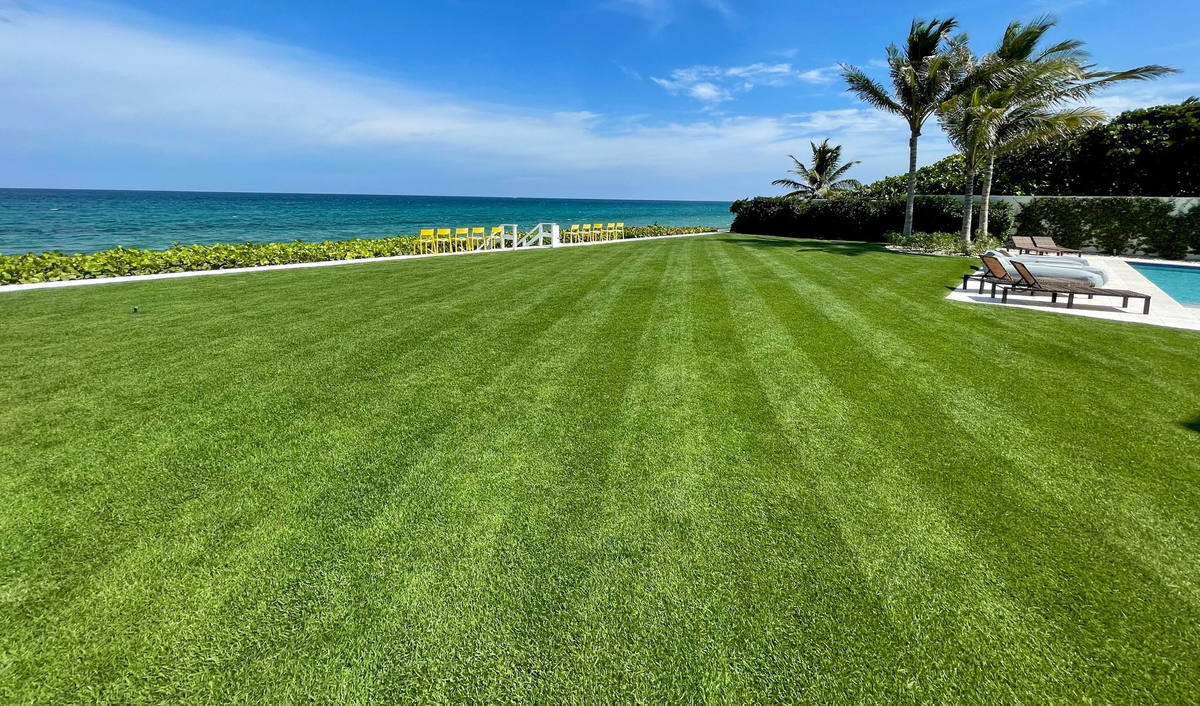
The finish everyone sees is the result of the work nobody sees
— aerification, verticutting, top-dressing, and a reel-mow schedule dialed to the grass type.
What to Ask Before You Hire Anyone to Do This
If you're evaluating a company to run a turf health program on your property, these are the real questions:
- Do you own your own aerifier, verticutter, and top-dresser — or are you subbing it out?
- How do you decide when to core-aerify vs. tine-aerify, and why?
- How do you measure thatch before recommending a verticut?
- What sand or top-dressing material do you use, and why that blend for my grass type?
- Do you reel-mow, and if so at what height for my specific turf?
- Can I see before/after photos of a lawn you've taken through a full first-year program?
If the answers are vague — "we fertilize a lot," "we'll figure it out," "our main guy handles that" — keep looking. A real program is specific, sequenced, and the crew running it knows exactly why each step matters.
Grass at the level you're paying for should look like it. The difference between "fine" and "show finish" is almost never the grass itself — it's whether anyone's doing the work underneath.