Sod Installation Near Me — A South Florida Owner's Guide to Getting It Right the First Time
You're typing “sod installation near me” because something needs to be replaced. Maybe a stretch of dead grass that didn't make it through summer. Maybe an entire front lawn that's been losing ground for years. Maybe a complete reset before the season starts.
The frustration is the same. So is the fear that if you pick the wrong company, the new sod will look worse than the old one by next September.
This is a guide written by Jorden Ross, owner-operator at Florida Boys Lawn & Landscape, after seventeen years of installing sod in Boca Raton, Delray Beach, Pompano Beach, Lighthouse Point, Deerfield Beach, Highland Beach, Hillsboro Beach, and Gulf Stream. It's the same brief I give every owner who calls.
Why most sod jobs fail in South Florida
Most sod installations in South Florida don't fail because of bad luck. They fail because of one of five predictable mistakes:
1. Wrong grass for the location.
Bermuda or Paspalum put under heavy oak shade can fade, thin out, then die off within a few short months. Empire Zoysia laid in salt-spray and unprotected windy zones can brown out the top portion during the heavy winter winds. The mistake usually happens when an installer carries one or two grass varieties and recommends them regardless of the property.
2. Rocky and sandy soil with no prep.
South Florida soil is mostly sand. And more importantly, on post-new-construction homes without soil amendments, the lawn will surely fail and not thrive — it's planted on top of all the road rock pushed around to close out the permit and get a rushed certificate of occupancy. Fresh sod laid directly on road rock or unamended sand can't establish roots before the first heat wave. The dirt looks fine. The sod looks fine for a few weeks. Then the establishment window closes and the lawn begins to look patchy in color, stripped of nutrients, and quietly dies from below.
3. Active fungus or pests left untreated.
If your old lawn died of brown patch or chinch bugs, putting fresh sod on top of the same soil is paying twice for the same problem. The pathogen is still there in the soil. The new sod looks great, then feels spongy, then begins the death spiral from being placed on top of a layer of old, infected ground.
4. Drainage issues nobody addressed or discussed.
Standing water means the sod's roots sit in saturated soil. Then it rots. By the time you see it on the surface, you've lost 50–60 percent of your lawn. The time to address drainage is during the removal and prep stage — either with minor grading and detailed leveling, or with a complete overhaul and removal of existing soil and the addition of proper soil mixture profiles and grades for water control and aesthetics.
5. Wrong installation timing.
Most grasses need a specific establishment window. Knowing when to delay or speed up installation a little can mean the difference between getting a healthier crop and watching slow establishment turn into weed pressure and thin coverage.
What “right the first time” actually means
At Florida Boys we approach sod the same way we approach the rest of the property — slow, deliberate, walked first. Here's what that looks like in practice:
- Soil test when applicable and needed. A soil test tells us pH, nutrient profile, and what amendments your specific patch needs.
- Grass selected for the specific property. Not “we use green grass.” We walk every zone, note the sun exposure, account for the trees, the pool screen, the wear and tear from kids and dogs, and the way the irrigation hits the area. We discuss desired outcome and flag any zone that may be problematic. Then we select the best grass type for the result you actually want.
- Existing irrigation audited and adjusted before install. A new lawn dies fast on a system designed for the old one. We test every irrigation zone, fix or flag what's broken, and adjust runtimes for optimal sod establishment given the upcoming weather.
- A 30-day care plan the homeowner gets in writing. What to water and when, when to first mow, when to first fertilize, what to look for, when to call. No guessing.
- A real human reachable during the establishment window. That's me. Call or text Jorden directly at (561) 886-7982 if anything looks off in the first 30 days.
- On-site inspections during the critical establishment phase. We come back personally during the first 7–14 days — the make-or-break window for new sod — to confirm the watering, the rooting, and the response are all on track.
The sod and grass types we typically install in South Florida
There are dozens of sod varieties marketed in Florida. We install across four families — Zoysia, Paspalum, Bermuda, and St. Augustine. Each variety is selected for a specific use case, not because we have a deal with a wholesaler.
A ★ star marks our favorite varieties within each family.
Zoysia
The premium, fine-bladed option for owners who want the golf-course look. Lower water needs once established, but slower to recover from damage and slower to fill in.
Best fit overall: established properties where the owner is investing long-term and willing to wait through a slower establishment window for a tighter finish.
★ CitraZoy Zoysia
University of Florida release bred specifically for Florida heat, humidity, and pest pressure. Fine-bladed, deep green, with better shade tolerance than most zoysias.
Best for: Florida coastal properties that want zoysia performance from a variety actually bred for our climate.
★ Diamond Zoysia
Ultra-fine, golf-green quality. Requires a reel mower and the highest maintenance touch of any home turf. The tightest, most manicured finish available.
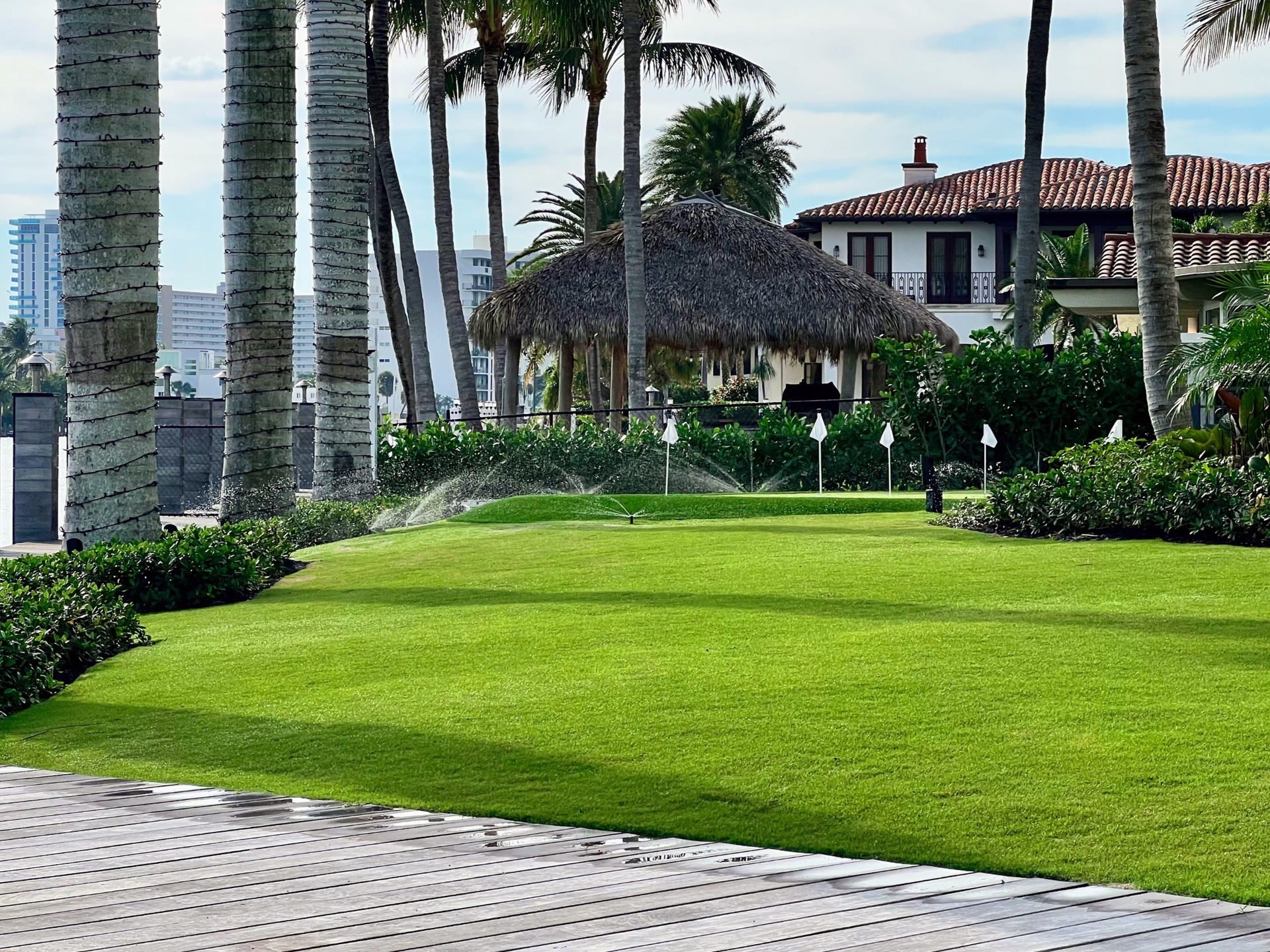
Best for: showpiece front lawns, putting greens, and croquet-grade installations where the owner wants a tournament-quality cut.
Empire Zoysia
Medium-bladed and the most forgiving zoysia on the market. Easier to mow, easier to maintain, and recovers faster than the fine-bladed varieties.
Best for: owners who want zoysia's density and feel without the reel-mower commitment Diamond requires.
Paspalum
The oceanfront option. Salt-tolerant, salt-spray-resistant. Holds up in coastal soil where every other grass species browns out.
Best fit overall: oceanfront estates with direct salt exposure or wells with elevated salt content.
★ Platinum TE Paspalum
The premium paspalum. Finer blade, deeper color, and the most refined finish available among salt-tolerant grasses.
Best for: high-end oceanfront estates where salt tolerance is non-negotiable and the owner still wants a manicured aesthetic.
★ Seashore Paspalum
The industry-standard salt-tolerant turf, used on coastal golf courses across Florida. Tougher, more economical, slightly coarser than Platinum TE.
Best for: coastal properties needing reliable salt resistance across the broader lawn area without paying the Platinum premium.
Bermuda
Fine-bladed, dense, and the fastest recovery of any warm-season turf. Demands full sun, a weekly mow cadence, and a steady fertility program — but delivers a true sports-field finish that holds up under heavy use.
Best fit overall: full-sun properties with active use — kids, dogs, putting-style aesthetics — where the owner wants a tight, manicured cut and is committed to higher-touch maintenance.
★ Bimini Bermuda
Hybrid release bred for South Florida conditions. Fine-textured, deep green color, with stronger density and noticeably better shade tolerance than most bermudas. Aggressive, self-repairing growth fills divots and worn spots faster than Celebration, and it holds color through heat and drought stretches that fade other varieties.
Best for: full-sun to light-shade residential properties where the owner wants a premium bermuda finish with deeper year-round color, faster recovery from wear, and a slightly more forgiving variety than the older bermuda standards.
★ Celebration Bermuda
Blue-green color, slightly better shade tolerance than most bermudas, and excellent wear recovery. The most common premium bermuda for high-end residential.
Best for: full-sun residential lawns where the owner wants a refined bermuda look with strong wear performance.
TifTuf Bermuda
University of Georgia release bred for drought efficiency. Uses notably less water than other bermudas while holding color and density during dry stretches.
Best for: properties on metered water, well systems, or under irrigation restrictions where water efficiency matters.
Latitude 36 Bermuda
Dense, cold-hardier than most bermudas, and built for high traffic. Strong choice where the lawn takes heavy foot use.
Best for: active families, pet-heavy properties, or any lawn that needs to take a beating and keep its color.
St. Augustine
The Florida default — broad-bladed, fast to establish, and forgiving. Different varieties handle shade and pest pressure very differently, so variety selection matters more than people think.
Best fit overall: most standard Florida residential lawns where reliable color and quick establishment outweigh the need for a fine-bladed finish.
★ CitraBlue St. Augustine
Newer UF release. Distinctive blue-green color, denser growth pattern, and meaningfully better shade tolerance than Floratam.
Best for: properties with mixed sun-and-shade zones where Floratam thins out under canopy.
★ Palmetto St. Augustine
Semi-dwarf, finer-textured for a St. Augustine, and more shade-tolerant than Floratam. Holds up under oak canopies and pool screens.
Best for: properties with significant shade or partial-sun zones where the owner still wants the St. Augustine feel.
ProVista St. Augustine
Genetically engineered for slower vertical growth and herbicide tolerance. Fewer mows per year, easier weed control, premium price point.
Best for: owners who want to reduce mowing frequency and are willing to pay for the technology.
Floratam St. Augustine — we don't install this.
Floratam is the South Florida default for low-end installs, and it's still pushed hard by wholesalers. We've watched it underperform on too many properties — thinning under shade, struggling against shade and pest pressure, and aging poorly compared to the newer UF releases. We won't recommend it, and we won't install it.
How sod installation costs break down in South Florida
There's no honest national pricing for sod installation. Every quote depends on your property, your grass selection, the prep work needed, the grading involved, and the haul-off. But here's the South Florida range:
- Materials: Sod by the pallet or by the square foot. Soil amendments by the cubic yard or truckload as needed.
- Labor and delivery: Typical day rate per crew member, plus delivery. For most residential installs, this is the largest line item.
- Soil prep: Killing off old grass and weed pressure, removing the existing dead lawn, amending the soil based on the soil test (when needed), grading, and leveling. This is where most low-cost installs cut corners.
- Total range: Most South Florida residential sod installs land between $1.50–$10 per square foot installed, depending on grass selection, prep depth, grading, soil amendments, and any irrigation repairs needed to set the lawn up to thrive.
Why the cheap quote almost always costs more. The $1/sq ft installer skips the soil test, lays Floratam everywhere, and skips drainage, site prep, grading, and amendments. A few weeks in, half the lawn is full of weeds and the other half is dead — and you're paying again to do it the way you wanted it done in the first place. The right way.
The 30-day care schedule that decides whether your lawn survives
Sod survives or dies in the first 30 days. Get the watering wrong and no warranty in the world brings it back. Here's the schedule we send every customer the day of install:
- Week 1: Water 2–5 times per day, 15–20 minutes per zone. The goal is keeping the soil under the sod consistently damp, not flooded. No foot traffic. No mowing.
- Week 2: Water tapers to 1–3 times per day. Still no mowing. Roots are starting to grip into the soil. Light foot traffic OK if you must, but minimize.
- Week 3: Water 1–2 times per day, deeper soak. First mow lands somewhere between day 10 and day 21 depending on the grass. Cut heights: 3.5″ for St. Augustine, 1″–2″ for Zoysia, ½″–1″ for Bermuda and Paspalum.
- Week 4: Water back to a normal cycle (typically 2–4 times per week, deep soak). Regular mowing resumes. First fertilizer goes down at 30–60 days — slow-release blend appropriate for the grass type. See our turf health care program for the long-term care schedule.
If it rains heavily during establishment, skip the next watering cycle. Saturated soil is worse than dry soil at week 1.
We follow up with every customer at days 7, 14, and 30. If anything looks off, we adjust before it becomes a problem.
When NOT to install sod
There are situations where putting in fresh sod is throwing money away. We tell customers this before quoting, even when we'd lose the install:
- The drainage problem isn't fixed yet. If water pools in the area you want sod, fix the drainage first. Otherwise you're paying to drown new grass.
- Active fungus or pest infestation. Treat the soil first. We'll come back in 30–60 days when the pathogen load is down.
- Wrong season for the grass type. Sometimes the right move is to wait six weeks.
- Irrigation that doesn't reach the area. New sod without coverage is dead sod. Either fix the irrigation first, or we're not the right contractor for this job.
- Underlying compaction. Areas where construction equipment ran or where heavy clay-fill was dumped can't support sod root systems without aeration and amendment. Not always a stop-the-job issue, but always a scope-the-job issue.
Walk Your Property With Us
We start every sod project the same way. We meet you on the property, walk it together, look at the dead spots, the irrigation, the trees, the soil. We test the soil. We talk through which grass actually fits your yard. Then we put together a plan you can read in five minutes — what we'd recommend, what you'd pay, what you'd get, what we'd warranty against.
No pressure. No upsell. If a different contractor is the right fit for your situation, we'll tell you.
Service area: Pompano Beach, Hillsboro Beach, Lighthouse Point, Deerfield Beach, Boca Raton, Highland Beach, Delray Beach, and Gulf Stream.

About the Author
Jorden Ross is the owner-operator at Florida Boys Lawn & Landscape. Third-generation South Floridian, seventeen years in the field, still walking properties personally. Florida Boys serves coastal homes from Pompano Beach to Gulf Stream.